



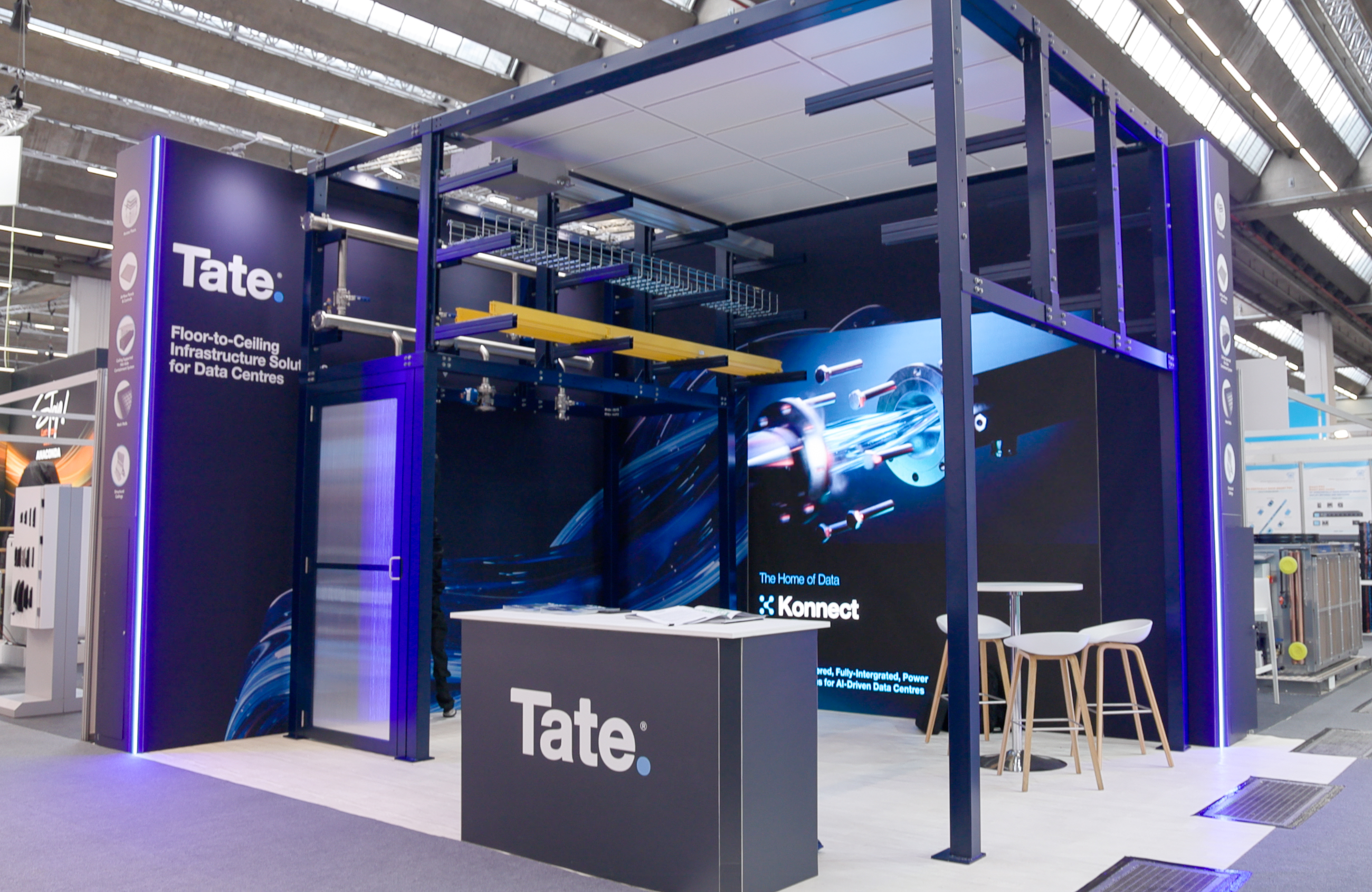
Data Centre World Frankfurt is both a major European gathering of data centre leaders and a commercially significant event for the industry. It offers visitors outstanding opportunities to firm up connections, share innovations, identify trends, and discuss new collaborative opportunities.
This year, the exhibition drew a large attendance from across the DACH region, with contractor, architect, developer and operator communities all well represented. For us, DCW Frankfurt 2026 was a chance to deepen existing relationships and engage directly with local contractors and architects.
The constant backdrop to our conversations, as elsewhere, is how we can best support a market under visible pressure.Projects are being delayed by tenant-driven redesigns, while labour constraints are tightening delivery windows. Meanwhile, project planning is increasingly focusing on the future; infrastructure decisions today are being shaped by what operators might need in three years. This is an industry is seeking to be build agility into major capex projects, to accommodate major transformation within the sector over the short- to medium-term.

A market in transition
Commercial conversations ranged from general contractors and MEP consultants through to developers and end users, with several focused on active opportunities and upcoming regional deployments.
One of the strongest themes running through the event was change. In the face of a rapidly evolving commercial landscape, operators are rethinking infrastructure design, cooling architecture and long-term flexibility.
Rather than optimising purely for day one performance, customers are focused on building environments that can evolve without major rebuilds as density and cooling requirements continue to shift.
One of the more notable shifts involved growing interest in overhead service distribution as an alternative to traditional raised-floor dependency.
Ceiling infrastructure is now being reconsidered as an integrated layer supporting cooling distribution, containment, cable management and overhead busway systems.
It is a direction that aligns closely with Tate's market-leading structural ceilings, which are designed to suspend loads, such as electrical and mechanical services, within data centres. They can easily accommodate high-performing building services, and can be installed quickly and cost-effectively.
Liquid cooling and AI-readiness
Liquid cooling systems also dominated the event.
As has been evident at other major European data centre exhibitions in 2026, liquid cooling is now a mainstream planning requirement rather than a specialist consideration.
Our range of manifolds, valves and hoses were on display in Frankfurt, which prompted a number of questions from visitors as to how liquid cooling manifolds can be integrated within existing environments. We were able to show that our steel solutions are particularly well suited to supporting this transition, and deliver a durable, high-quality, smooth operational performance.
AI-readiness was a consistent thread, with density requirements driving decisions across cooling, power and containment, not just on the compute side.


Modularity and deployment pressure
Labour availability and deployment timelines came up repeatedly as growing operational concerns. Both are accelerating demand for pre-engineered systems that reduce on-site coordination and compress programme delivery.
Visitors were particularly interested in Tate’s Konnect system as a factory-built solution. Konnect brings power, liquid cooling manifolds, connectivity and air handling together within a single coordinated system.
Tate is a supplier that can manage faster, broader infrastructure installations of fully compatible systems, rather than simply selling individual product packages, and this value was a recognised and recurring point within our conversations.
As Liam Coughlan, Tate’s Business Development Executive, put it, “Time is fast becoming the currency of the industry.”
Liquid cooling and AI-readiness
Liquid cooling systems also dominated the event.
As has been evident at other major European data centre exhibitions in 2026, liquid cooling is now a mainstream planning requirement rather than a specialist consideration.
Our range of manifolds, valves and hoses were on display in Frankfurt, which prompted a number of questions from visitors as to how liquid cooling manifolds can be integrated within existing environments. We were able to show that our steel solutions are particularly well suited to supporting this transition, and deliver a durable, high-quality, smooth operational performance.
AI-readiness was a consistent thread, with density requirements driving decisions across cooling, power and containment, not just on the compute side.

Ongoing direction
DCW Frankfurt reinforced a consistent picture and prevailing themes across Europe’s data centre sector. Operators are prioritising infrastructure that can adapt to rising density demands, evolving cooling strategies and compressed deployment timelines without requiring major future rework.

For more information, discover Konnect by Tate