






AI’s compute density challenge is ultimately an adaptability challenge.
Large-scale AI training and advanced inference workloads are concentrating unprecedented levels of processing capability at rack level. They rely on large numbers of GPUs and other accelerators operating in parallel, supported by high-bandwidth memory and low-latency interconnects. As these systems scale, compute resources need to be positioned physically closer together to support high-speed communication, increasing rack density and placing new demands on the infrastructure around them.
One Density Does Not Fit All
However, a shift towards higher compute density is not uniform across the industry. Large-scale AI training sits at one end of the spectrum, with conventional business IT sitting at the other, typically operating at considerably lower densities.
Between the two is an increasingly varied mix of AI inference, enterprise AI and other accelerated computing workloads. The result is not a wholesale transition towards a single, higher rack density, but a broader range of compute profiles that data centres need to accommodate.
For operators, this makes flexibility critical. Infrastructure must be capable of supporting high-density accelerated compute where required without assuming that those densities will apply throughout a facility or remain static over its lifetime. Power and cooling requirements may change as workloads, hardware and deployment strategies evolve.
The challenge at play is not simply preparing for ever-higher density. It is creating an environment that can adapt to different requirements without locking the data centre into a single configuration.
Adaptability By Design
At Tate, our Konnect modular infrastructure solutions are designed to help operators respond as requirements evolve.
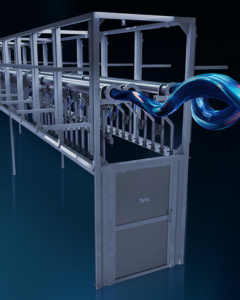
For high-density deployments, our liquid cooling manifolds enable direct-to-chip cooling by delivering coolant from the CDU to the rack, while our structural ceilings can support high electrical and mechanical service loads. But managing variable-density compute is about more than any individual component. Cooling distribution, load-bearing capacity, service routing and containment all need to work together, creating a coordinated infrastructure approach for both new-build and retrofit environments. For this reason, both integration and adaptability are at the heart of our solutions. We understand that the challenge is not predicting exactly what the next generation of compute will require – it is building enough flexibility into the physical infrastructure to adapt when those requirements change.
Contact us to discover how Tate's modular solutions are accelerating deployment of the next generation of data centre infrastructure.