






The AI-driven infrastructure challenges facing the data centre industry extend far beyond adding more servers.
The scale of these challenges is becoming clearer. The International Energy Agency (IEA) reported that electricity demand from data centres rose by 17% in 2025, with demand from AI-focused facilities growing even faster. Looking ahead, it expects overall data centre electricity consumption to double by 2030, while consumption from AI-focused data centres is set to triple.
But securing enough power is only part of the equation. With ever-increasing computing demands, energy efficiency is becoming increasingly important. The goal is not simply to bring more power into a facility, but to make the best possible use of what is available. The ability to translate available power into greater computing capacity, while minimising energy lost across supporting infrastructure, will be key to enabling continued growth. The question is no longer simply whether enough capacity can be built, but how efficiently available power and space can be converted into computing capacity.
The Infrastructure Equation Is Changing
The power challenge posed by AI starts with the computing itself. AI models are trained and run on servers using specialised accelerators such as GPUs, increasing the amount of intensive computing taking place within data centres. At scale, that demand is significant - even as the amount of power consumed per individual AI task falls, electricity use from AI-focused data centres is growing faster than the wider data centre sector.
In striving for maximised energy efficiency, gains can be made in multiple areas. Significant variations in energy use can be evident throughout a data centre, for example the IEA reporting that cooling accounts for around 7% of total consumption in efficient hyperscale data centres, compared with more than 30% in less-efficient enterprise facilities. This demonstrates the wider opportunity in terms of AI readiness – as AI places greater demands on available power, reducing the energy consumed by supporting infrastructure can leave more capacity available for the computing itself.
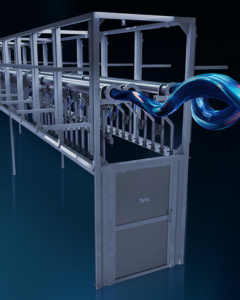
At Tate, we're looking at that equation across the data centre as a whole. By integrating power distribution, containment and supporting infrastructure, we're helping customers make better use of available power and white space, support increasing computing densities and retain the flexibility to adapt as AI requirements evolve.
Designing For What Comes Next
When we design for efficiency, we can’t simply design for one fixed version of the future. AI hardware and workloads continue to evolve, making flexibility increasingly valuable. Infrastructure that can accommodate changing densities and future expansion gives operators greater scope to respond as requirements develop, rather than having to fundamentally rethink the data hall each time computing technology advances.
Ultimately, the data centres best equipped for the next phase of AI will be those that can combine efficiency with adaptability, extracting greater computing capacity from available resources while remaining ready for what comes next. The next phase of AI infrastructure won't be defined by power availability alone. It will be defined by how intelligently that power, space and infrastructure are used. For operators, that means designing data centres that can deliver more computing capacity from available resources, while retaining the flexibility to accommodate tomorrow’s technology.
Contact us to discover how Tate can help you maximise available power, white space and infrastructure performance in increasingly demanding data centre environments.