




EPDs: Find, Understand & Compare

Tate EPDs provide independently verified environmental performance information across defined stages of a product's life cycle. 

They help architects, engineers, contractors and sustainability professionals understand embodied carbon and other environmental impacts when comparing products and making specification decisions.

Tate Emea Sustainability Hub Clodagh Epd Image En Ie
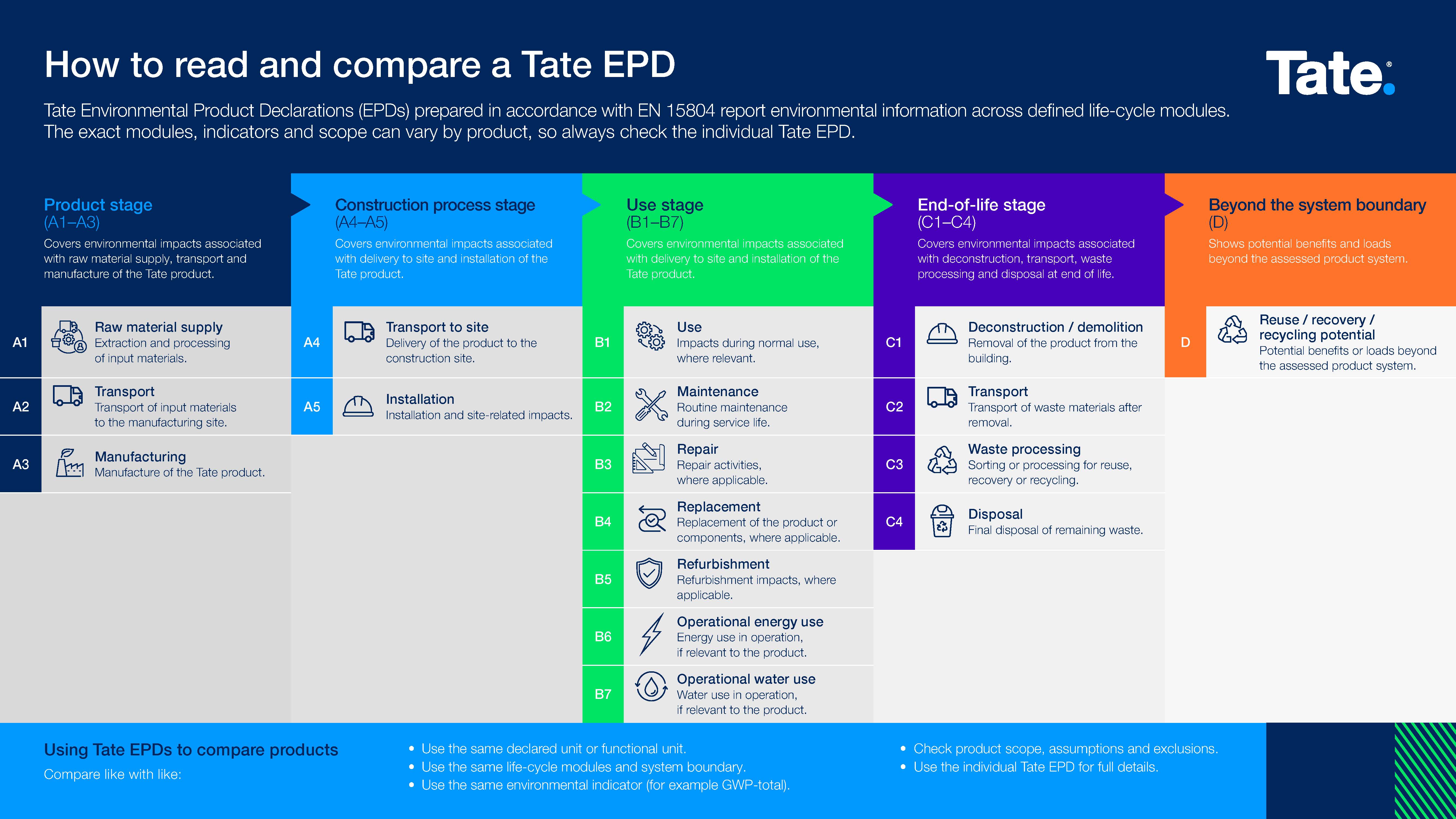
Tate Sustainability Hub Product Lifecycle Infographic En Ie

EPD Insights

An Environmental Product Declaration (EPD) is a third-party verified document that transparently reports the environmental impact of a product throughout its life cycle. Based on a Life Cycle Assessment (LCA), an EPD provides measurable data on factors such as carbon emissions, energy use, resource consumption and waste generation. 

EPDs are designed to help architects, engineers, contractors and building owners make informed decisions when selecting products for sustainable construction projects. EPDs offer a consistent and credible way to compare environmental performance across similar products because they follow recognised international standards. 

For organisations pursuing green building certifications such as LEED or BREEAM, EPDs can also contribute valuable documentation during the certification process.  

When reviewing Environmental Product Declarations, it is important to compare products on a like-for-like basis. Look for EPDs that: 

  • Follow the same Product Category Rules (PCRs) 

  • Measure the same functional or declared unit 

  • Cover the same life cycle stages 

  • Use the same environmental impact indicators 

  • Have been verified to the same standards 

Key metrics to compare often include: 

  • Global Warming Potential (GWP) or embodied carbon 

  • Energy consumption 

  • Water use 

  • Resource depletion 

  • Waste generation 

An EPD should not be viewed as a simple "good" or "bad" score. Instead, it provides transparent environmental data that allows project teams to evaluate products fairly and make informed specification decisions based on project sustainability goals. 

Tate's Environmental Product Declarations are developed and verified in accordance with internationally recognised environmental reporting standards. 

These standards typically include: 

  • ISO 14025: Environmental labels and declarations, Type III environmental declarations 

  • EN 15804: Sustainability of construction products and environmental product declarations 

  • Relevant Product Category Rules (PCRs) for the specific product category 

Following these standards ensures that EPD data is consistent, transparent and independently verified, allowing customers, consultants and certification bodies to confidently assess environmental performance.  

EPDs can support project teams by providing verified environmental data for materials, embodied-carbon studies, whole-building life cycle assessment and product transparency requirements. Their exact contribution depends on the scheme, version, project type and assessment route. An EPD does not make a product "certified" under a building scheme and does not automatically secure credits or points. 

  • LEED - EPDs can support Materials and Resources requirements relating to environmental product disclosure and embodied-carbon or life-cycle assessment. 

  • BREEAM - verified EPDs can support relevant Materials issues and project-level assessment of the environmental impacts of construction products. 

  • DGNB - verified product environmental data can feed building level life cycle assessment and broader environmental quality evaluation. 

  • WELL - product transparency is relevant, although WELL places stronger emphasis on occupant health and material ingredient disclosure; EPDs may therefore form part of a wider evidence package rather than being the primary document for every feature. 

  • Estidama - Pearl Rating System - material stewardship and whole-life considerations are part of the assessment framework, so environmental product data can support material selection and project evidence where applicable. 

  • GSAS (formerly QSAS) - the framework includes a Materials category and a life-cycle approach; EPD and LCA information can support assessment where relevant to the applicable criteria. 

Other regional, client or project-specific frameworks may also request EPDs, product carbon data, responsible sourcing evidence, VOC information or other product sustainability documentation. Project teams should always confirm the current scheme version and assessor requirements. 

EPDs help project teams make more sustainable product selection decisions by providing verified environmental data during the design, specification and procurement stages. 

You can use EPD information to: 

  • Compare the environmental impacts of similar building products 

  • Support embodied carbon reduction strategies 

  • Contribute documentation for LEED, BREEAM and other green building certification schemes 

  • Meet sustainability reporting requirements 

  • Support corporate ESG and decarbonisation objectives 

  • Improve transparency in material selection and procurement decisions 

For data centre, commercial and mission-critical projects, EPDs can help stakeholders understand the environmental impacts associated with building materials and identify opportunities to reduce the overall carbon footprint of a development. 

Your Partner in Sustainable Progress

Whether you're reducing embodied carbon, pursuing certification targets, or advancing circularity initiatives, we're here to help you make informed decisions and achieve meaningful environmental outcomes.