



Artificial intelligence (AI) has long captivated human imagination, but recent advancements in compute power have transformed AI from science fiction to reality. The explosion of processing power, driven by Moore's Law—which states that the number of transistors on a microchip doubles roughly every two years—has been the true catalyst for AI's recent surge. This exponential growth has provided the computational muscle needed to train complex AI models, leading to ever-increasing capabilities.
The COVID-19 pandemic further accelerated this trend. As lockdowns forced societies online, the demand for AI applications skyrocketed. AI-powered tools facilitated remote work, virtual healthcare, and automated logistics. This widespread adoption provided valuable real-world data, further fueling AI development.
The convergence of these factors has brought AI to a tipping point. AI is no longer a novelty; it’s becoming ingrained in daily life. Facial recognition unlocks smartphones, chatbots answer customer queries, and AI algorithms personalize our online experiences. These interactions weave AI into the fabric of our daily routines, making it a form of technological muscle memory. However, large-scale adoption hinges on overcoming the processing power challenge, particularly for deep learning models, which require immense computational power. Training these models involves processing massive datasets, pushing the limits of traditional CPUs (Central Processing Units). The shift towards high-performance GPUs (Graphics Processing Units) and specialized AI accelerators further escalates power consumption within data centers.
The Heat is on: Cooling Challenges
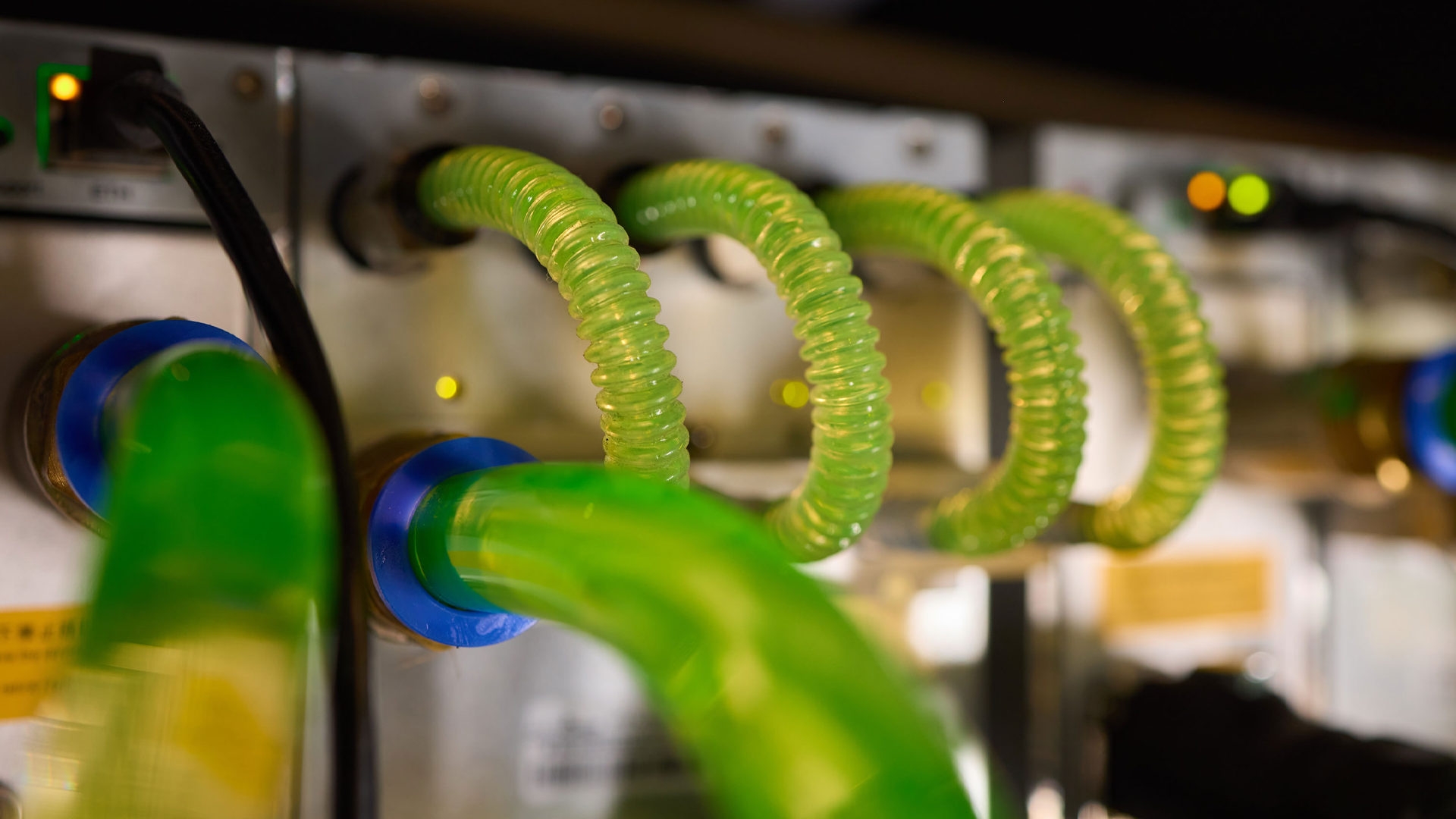
The increased power consumption of AI hardware translates to significant heat generation. Traditional air-cooling methods struggle to keep pace with the thermal demands of high-density AI clusters, necessitating alternative cooling solutions, such as liquid cooling systems, which offer superior heat dissipation.
Data centers, the humming engines of the digital age, face significant cooling challenges as AI applications become more complex. Traditional air-cooling systems, which rely on circulating air to remove heat, can’t keep pace with the demands of AI.
Here's why air-cooling falls short:
- Physics vs. Power: Air has a lower thermal capacity than liquids. It takes more air to absorb the same amount of heat compared to liquids like water. As AI hardware becomes more powerful, the volume or flow rate of air needed to cool them effectively becomes impractical.
- Density Dilemma: Data centers constantly strive to pack more processing power into smaller spaces. Unfortunately, cramming servers closer together creates pockets of hot air that traditional air-cooling struggles to disperse efficiently.
The consequences of relying on air cooling in an AI-powered data center can be dire:
- Thermal Throttling: Servers automatically reduce performance to avoid overheating, leading to slower AI processing and bottlenecks.
- Hardware Damage: Chronic exposure to high temperatures can shorten the lifespan of delicate server components.
- Energy Inefficiency: Air cooling systems often work harder to compensate for rising temperatures, leading to increased energy consumption.
Liquid Cooling: A Cooler Future for AI
Liquid cooling offers a more effective way to manage the heat generated by AI hardware. Here's how:
- Superior Heat Absorption: Liquids have a significantly higher thermal capacity than air, allowing them to absorb and transfer heat away from servers much more efficiently.
- Targeted Cooling: Liquid cooling systems can deliver coolant directly to the hottest parts of a server, ensuring precise temperature control.
- Packing More Power: With efficient heat removal, data centers can pack more computers into a smaller space, maximizing processing power per square foot.
The benefits of implementing liquid cooling for AI workloads are numerous:
- Increased Performance: By eliminating thermal throttling, AI applications can run at peak performance without sacrificing speed.
- Improved Reliability: Lower operating temperatures extend the lifespan of server components, leading to less downtime and maintenance.
- Enhanced Efficiency: Liquid cooling systems can significantly reduce the ratio of energy consumption required to maintain optimal temperatures to processing output.
Raised Access Floors: A Platform for Liquid Cooling Success
Raised access floors, a common feature in data centers, plays a crucial role in facilitating liquid cooling deployments. These floors consist of modular panels supported by a raised structure, creating a hidden space beneath. This space becomes the perfect channel for housing the pipes and other components of the liquid cooling system. Raised access floors offer several advantages for liquid cooling:
- Improved Efficiency: By keeping the cooling infrastructure hidden beneath the floor, airflow for traditional IT equipment remains unobstructed, optimizing overall cooling efficiency.
- Simplified Maintenance: The raised platform provides easy access to the liquid cooling system for maintenance and repairs, minimizing disruption to ongoing operations.
- Scalability: As AI demands grow, the modular nature of raised access floors allows for easy expansion of the liquid cooling system to accommodate additional servers.
- Dedicated Pathways: The underfloor plenum provides a designated space for routing liquid cooling pipes, keeping them separate from power and communication cables. This segregation ensures safety and simplifies maintenance procedures.
- Leak Detection and Containment: Raised floors can be equipped with leak detection systems that can quickly identify and contain potential liquid coolant spills, minimizing damage to sensitive equipment and ensuring data center uptime.
- Cooling Unit Placement: Raised floors provide a platform for strategically placing liquid cooling units within the data center, optimizing cooling efficiency and minimizing heat recirculation.
Argonne’s Next-Generation Supercomputer
Argonne National Laboratory, a pioneer in scientific research and technological innovation, has embarked on deploying a next-generation supercomputer. This endeavor, pivotal for advancing computational capabilities, requires a state-of-the-art infrastructure to support the high performance, cooling, and scalability demands of contemporary supercomputing environments. One crucial component of this infrastructure is the raised floor system.
The new supercomputer at Argonne National Laboratory represents a significant leap in computational power and efficiency. It aims to support a wide range of scientific research, from molecular dynamics simulations to climate modeling, necessitating a robust infrastructure to ensure optimal performance and reliability. Key features of the supercomputer include:
- High computational density: Thousands of nodes and advanced GPUs.
- Massive power requirements: Efficient power distribution and management.
- Significant cooling demands: Advanced cooling solutions to manage heat dissipation.
- Scalability and flexibility: Infrastructure that supports future upgrades and expansions.
Importance of Raised Floor Systems
A raised floor system is critical in modern data centers, providing several benefits indispensable for the operation of high-performance computing environments:
- Efficient Airflow Management: Raised floors enable the creation of an underfloor plenum, essential for efficient cooling. By channeling cold air directly to the intake of servers, it enhances cooling efficiency and reduces energy consumption.
- Cable Management: The underfloor space allows for organized and accessible routing of power and data cables, reducing clutter and improving maintainability.
- Flexibility and Scalability: Raised floor systems offer flexibility in data center design and layout, facilitating easy reconfiguration and expansion as technology evolves.
- Improved Accessibility: Simplifies maintenance and upgrades, as technicians can access infrastructure components without disrupting operations.
Tate’s Raised Floor Solutions
Tate is a leader in the design and manufacture of raised floor systems, providing solutions that meet the rigorous demands of modern data centers. Key features of Tate’s raised floor systems include:
- High Load Capacity: Supports the weight of heavy server racks and other equipment. Present-day airflow panels can support heavy static and rolling loads.
- Modular Design: Allows for easy installation and reconfiguration.
Optimized Airflow Panels: Enhances cooling efficiency with high airflow, directional, and damper panel types that can be adjusted to meet specific cooling requirements. - Sustainable Materials: Uses eco-friendly materials, contributing to sustainable building practices.
The deployment of raised floors at Argonne has yielded several benefits:
- Enhanced Cooling Efficiency: The optimized airflow management has significantly improved cooling efficiency, reducing energy costs and improving the reliability of the supercomputer.
- Improved Accessibility: Maintenance and upgrades can be performed with minimal disruption, ensuring continuous operation.
- Scalability: The modular design of raised access floors allows for easy expansion and reconfiguration, supporting Argonne’s future computational needs.
The integration of raised access floors into Argonne National Laboratory’s next-generation supercomputer infrastructure has proven to be a critical component in meeting the high demands of modern high-performance computing environments. Raised access floors not only supports the heavy computational load but also enhances cooling efficiency, simplifies maintenance, and provides the flexibility needed for future growth. This deployment underscores the importance of advanced infrastructure solutions in enabling cutting-edge scientific research and technological innovation.
A Symbiotic Relationship
The synergy between AI and liquid cooling is undeniable. As AI continues to push the boundaries of processing power, liquid cooling emerges as the essential technology to ensure efficient and reliable operation. Furthermore, raised access floors (RAFs) are a cornerstone technology for modern data centers, especially those focused on AI and utilizing liquid cooling solutions. By enhancing airflow management, simplifying cable management, providing superior flexibility, and seamlessly integrating with liquid cooling infrastructure, raised access floors empower data center operators to achieve optimal performance, efficiency, and scalability in today's high-density computing environments.
Authored by Nabeel Mahmood, Tate Brand Ambassador and Top 10 Data Center Influencer
References
- Argonne National Laboratory. (2021). Argonne lays the groundwork for its next-generation supercomputer. Retrieved from Argonne National Laboratory.